Nearly every contractor who has been in business long enough has lived through some version of this. The job is done, the work is solid, the invoice went out, and somewhere between that moment and the one where the check should have arrived, the client went quiet. Not the kind of quiet that means the check is coming. The other kind.
How a contractor responds in the first thirty days after a payment dispute surfaces tends to matter more than anything that comes after it, partly because the legal tools available to contractors are time-limited in ways that catch people off guard, and partly because the documentation gathered or ignored in those early weeks is often what determines how the situation resolves.
- Start With Your Paper Trail Before You Do Anything Else
- Send a Formal Written Demand Before You File Anything
- Your Mechanic's Lien Rights Are Time-Limited and Non-Negotiable
- Public Work Has Different Rules: The Miller Act and Its State Equivalents
- Understand the Difference Between a Dispute and a Refusal to Pay
- How the Unpaid Invoice Affects Your Financial Picture Right Now
- The Bottom Line
Start With Your Paper Trail Before You Do Anything Else
Before making a phone call, sending an email, or doing anything else, the first thing worth doing is pulling together every piece of documentation connected to the job. The signed contract, every invoice, signed change orders, project photos showing completed work, lien waiver records, and any written communication where the client acknowledged scope, approved work, or confirmed completion. That file is the foundation of everything that follows, and its condition at this moment reflects decisions that were made, or not made, throughout the job.
If there is no signed contract, the situation is more difficult but not hopeless. Courts regularly enforce verbal agreements and implied contracts in construction disputes, and a clear pattern of invoicing, partial payment, and client communication can establish the existence of an agreement even without a signed document. But it is harder work, and the outcome is less predictable. If there is a contract and the client is claiming the work was defective or incomplete, the project documentation becomes the primary rebuttal, and a contractor who photographed the work regularly and kept written records of completion milestones is in a meaningfully stronger position than one who did not.
Know exactly what is owed and how the number breaks down. If retainage is being held separately from the outstanding final invoice, track those two figures independently. If disputed change orders are tangled up with the undisputed contract balance, separate them. The cleaner and more precise the demand, the harder it is for a client to obscure a straightforward refusal to pay behind complaints about a specific line item.
Send a Formal Written Demand Before You File Anything
A demand letter sent by certified mail with a specific payment deadline does two things at once. It creates documented proof that the contractor gave the client a clear and reasonable opportunity to pay before escalating, and it sometimes works on its own, because a client who has been ignoring phone calls will occasionally respond to formal correspondence in a way they never responded to informal follow-up.
The letter should state the amount owed, reference the contract and invoice numbers, identify the project by name and address, set a payment deadline of ten to fourteen days, and state plainly that legal remedies will be pursued if payment is not received by that date. The tone should be professional and factual without being threatening or emotional, because this letter may eventually be read by a judge or mediator, and the impression it makes in that context matters. Send it from the business address, not a personal email, and send it certified mail with return receipt so there is proof of delivery.
Your Mechanic's Lien Rights Are Time-Limited and Non-Negotiable
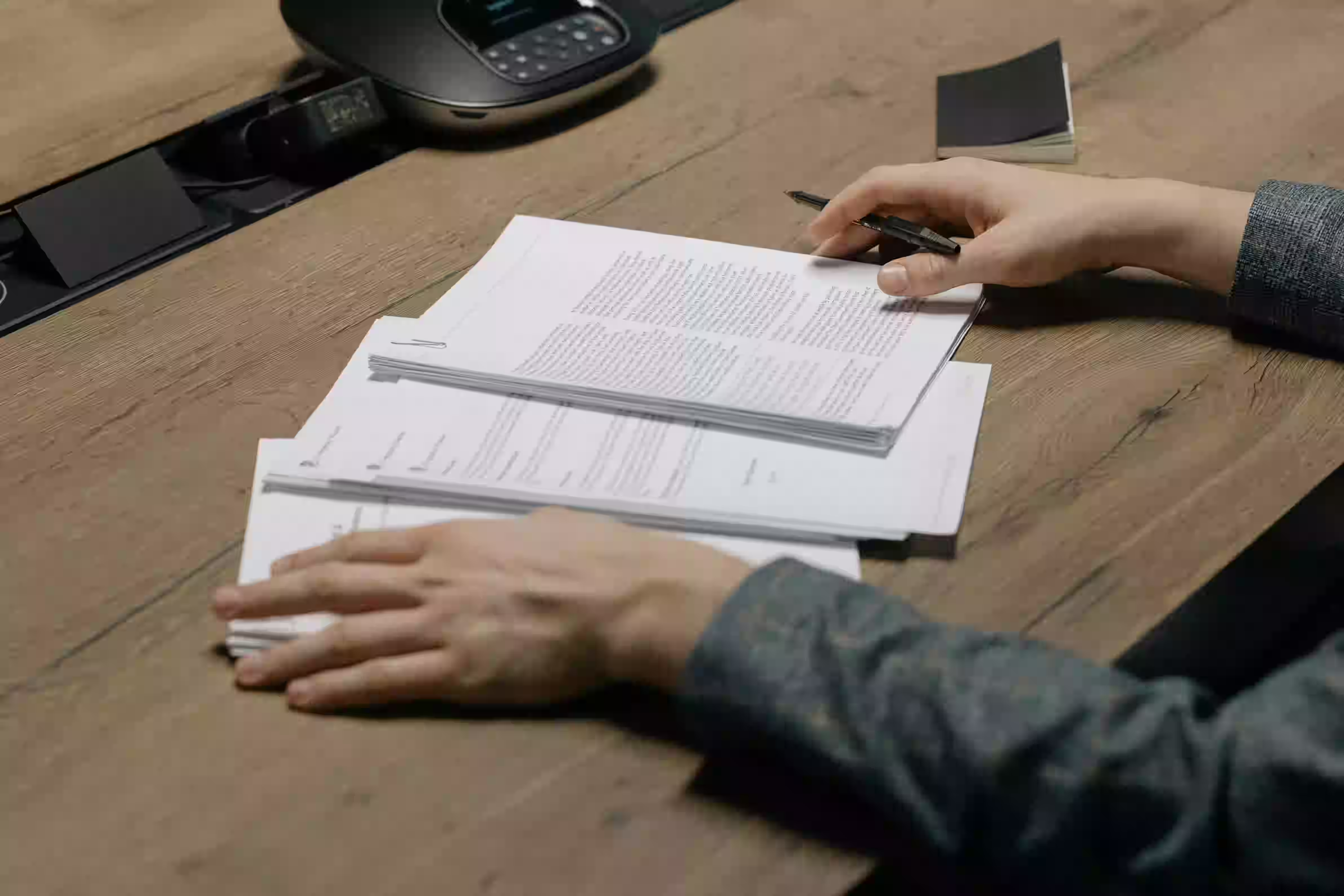
A mechanic's lien is a legal claim filed against the property where work was performed, and it is one of the most effective collection tools available to contractors because it clouds the property's title and can ultimately force a resolution through foreclosure proceedings. It also operates on a hard deadline that has no flexibility built into it. Every state sets its own rules governing how long a contractor has to file after completing work, what preliminary notice must have been sent before filing is permitted, and what the lien document itself must contain to be valid.
Miss the filing deadline by a single day and the lien rights are gone entirely, with no mechanism to recover them. California's mechanics lien procedures are governed by Civil Code Sections 8000 through 8848. In Texas, lien rights for private projects are governed by Property Code Chapter 53, with monthly deadlines tied to when labor and materials were furnished. The specific rules in every other state follow their own logic and their own calendar, and the only way to know the deadline with certainty is to look it up for the state where the work was performed before assuming there is time to wait and see.
The week a final invoice goes unpaid is the right time to look up the lien deadline, mark it on the calendar, and decide whether to file rather than waiting to find out whether the client comes around.
Public Work Has Different Rules: The Miller Act and Its State Equivalents
Federal public construction projects do not permit mechanic's liens against government property, so the collection tool for unpaid subcontractors and suppliers on those jobs is the Miller Act, a federal statute requiring prime contractors on federal contracts exceeding
State and local public projects operate under their own versions of the same concept, commonly called Little Miller Act statutes, with bonding thresholds and claim procedures that vary significantly by state. If the unpaid job was public work of any kind, the first question to answer is whether a payment bond exists on the project and what the notice and claim windows are before they close.
Understand the Difference Between a Dispute and a Refusal to Pay
A client who has a legitimate complaint about the quality or completeness of the work is a different situation than a client who has accepted the work, raised no material objection, and simply stopped responding to invoices. That distinction shapes which path makes sense to pursue and how aggressively.
When there is a real dispute about the work, walking into litigation or filing a lien without first attempting to resolve the underlying disagreement can make a contractor look unreasonable to a neutral third party, and some contracts require mediation or arbitration before any legal action is permitted. Reading the contract's dispute resolution clause before taking any escalation step is not optional in that scenario. When the dispute is manufactured, meaning the client has no legitimate complaint and is using vague objections to avoid paying for completed and accepted work, the tools available are the lien, the demand letter, small claims court for smaller balances, and civil litigation for larger ones. In many states, contractors who prevail in construction payment disputes are entitled to recover attorney fees as well, which changes the client's calculation about how long it is worth holding out.
How the Unpaid Invoice Affects Your Financial Picture Right Now
While the collection process plays out, the unpaid receivable is sitting on the books and affecting decisions that depend on the financials being accurate. A surety looking at the contractor's balance sheet sees an inflated receivable that may or may not be collectible. The WIP schedule shows a job that may look profitable on paper while the cash behind it never arrives. Working capital calculations, bonding capacity, and cash flow forecasting are all affected by how that receivable is classified and whether it has been honestly evaluated as collectible or at risk.
A receivable that is genuinely in dispute or showing signs of being uncollectible should be tracked separately from clean accounts receivable rather than carried at face value alongside invoices that are simply waiting for payment. The difference between those two categories matters every time a financial decision is made while the dispute is still open.
The Bottom Line
An unpaid final invoice is a legal situation with deadlines attached to it, and waiting to see how things develop is the one approach that reliably makes the outcome worse. Know the lien deadline for the state where the work was performed. Send the demand letter. File the lien if the deadline is approaching and payment has not arrived. The contractors who consistently collect what they are owed are not the ones who are more aggressive by nature. They are the ones who know their rights, move quickly when those rights are at risk, and treat the documentation of every job as something that might eventually have to stand up in front of a judge.
Ready to talk numbers?
Schedule a call with one of our construction accounting professionals.
Schedule a Call