At some point during a self-build, usually around the third or fourth week after breaking ground, almost every owner-builder hits a wall that has nothing to do with framing or concrete or any of the things they spent months planning for. The wall is paperwork. Specifically, it is the realization that the financial and legal infrastructure surrounding a construction project is its own full-time job, one that nobody handed them a manual for and that does not wait patiently while they figure it out. A sub needs to be paid but there is no lien waiver yet. The draw request went to the lender two weeks ago and nobody has called back. Someone just delivered a preliminary notice and it is not clear whether to be alarmed by it.
None of that chaos is inevitable. Most of it traces back to the same root cause, which is that the systems professional GCs run automatically in the background are not automatic for an owner-builder. They have to be learned and built from scratch, usually while the job is already moving.
- Job Costing Is How You Know If You're Still on Budget
- Construction Draws Are How Your Lender Controls the Money
- Every Sub on Your Site Needs to Prove They're Insured Before Work Starts
- A W-9 Has to Come Before the First Check, Not After
- Preliminary Notices Are Not Threats, They're Paper Trails
- Lien Waivers Are the Receipt That Proves You Actually Paid
- How Do You Keep All of This From Becoming a Full-Time Job?
- The Bottom Line
Job Costing Is How You Know If You're Still on Budget
A budget is not the same thing as a job cost system, and the difference between those two things becomes clear somewhere around the midpoint of a self-build when the budget says one thing and the bank account says something harder to explain.
Job costing is the practice of tracking every dollar of actual expenditure against a specific line in the original budget, in real time, throughout the entire project. On a custom home build, that means the budget is broken into categories, foundation, framing, rough mechanical, finish work, exterior, landscaping, and so on, and every invoice, every payment, and every change in scope gets matched to one of those lines before the money moves. The purpose is not to create paperwork. The purpose is to know, at any given moment during the build, exactly which lines are on track, which ones are already running over, and where there is still room to make decisions before a problem gets too expensive to fix.
Without that structure, the financial management of a self-build tends to collapse into a running total of money spent, which feels like enough information until the framing is done and the number is higher than expected and it is genuinely unclear where the difference went. By that point, the options available are more limited and more expensive than they would have been if the overrun had been caught two months earlier.
Construction Draws Are How Your Lender Controls the Money
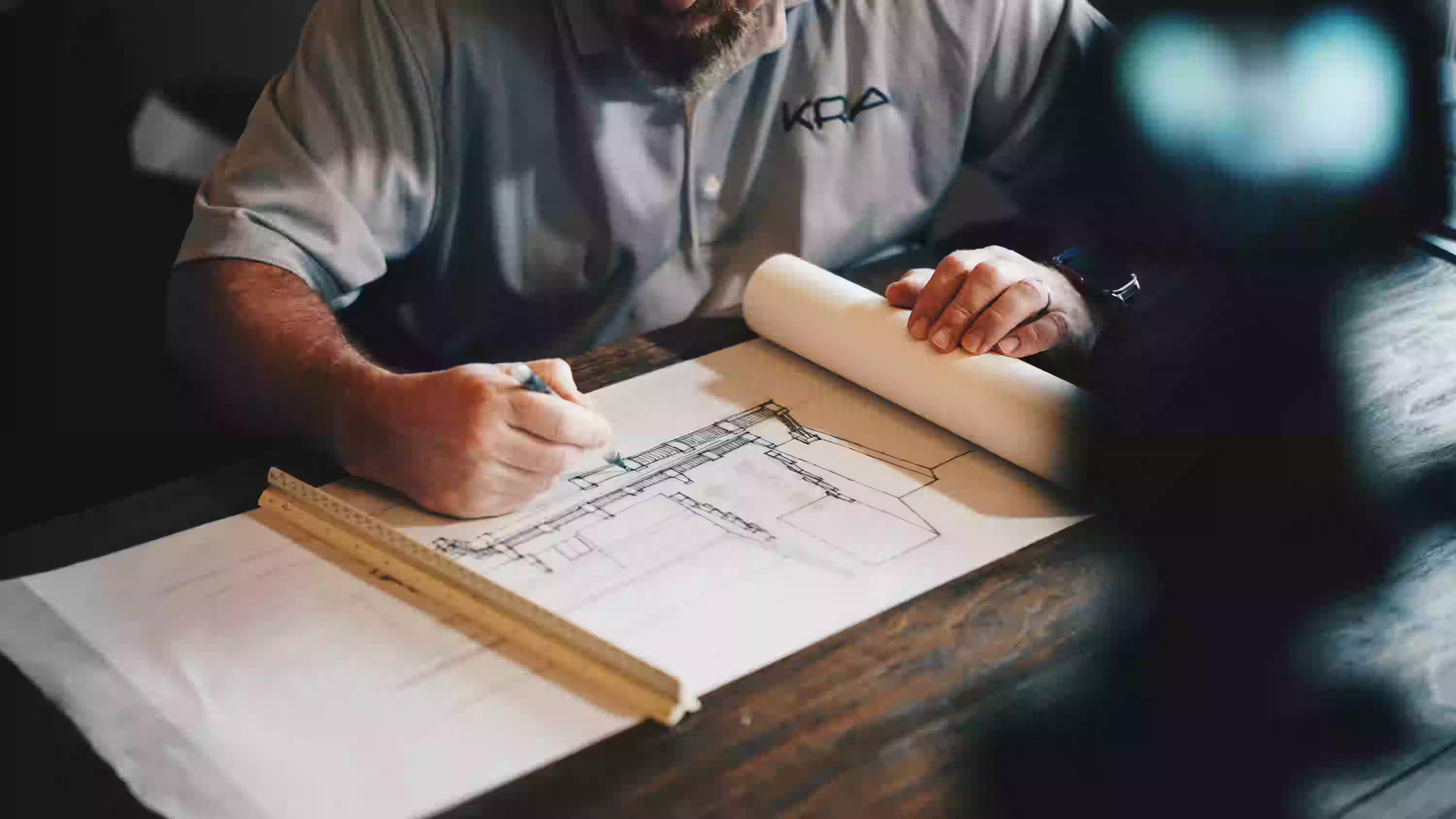
Most owner-builders are financing the project with a construction loan, and a construction loan does not work the way a mortgage works. The lender is not releasing the full approved amount at closing. They are releasing it in stages called draws, each one tied to a defined milestone or a verified percentage of completion, and each one requiring documentation that satisfies the lender before the money comes out.
A typical draw schedule might be tied to foundation completion, framing completion, rough mechanicals, drywall and insulation, and substantial completion, though the specific structure varies by lender and loan program. Before each draw is released, the lender usually requires an inspection confirming the milestone has been reached, along with documentation showing what has been paid and to whom. That documentation requirement is the part that creates friction for owner-builders who have been paying subs informally and keeping loose records, because the lender needs a paper trail that justifies the draw amount, and if the trail is not there, the draw gets delayed.
Delayed draws have consequences that compound quickly. The project keeps moving, subs keep working, materials keep arriving, and the owner-builder is covering those costs out of pocket while waiting for the lender to release funds that should already be available. Getting ahead of each draw request, submitting it early and with complete documentation, is one of the more valuable habits an owner-builder can build in the first month of the project.
Every Sub on Your Site Needs to Prove They're Insured Before Work Starts
A certificate of insurance, or COI, is a document a subcontractor provides confirming they carry general liability and workers' compensation coverage, and it needs to be in hand before anyone from that company sets foot on the property. Not after the first day of work. Not when the invoice arrives. Before the work begins.
The reason this matters so directly to an owner-builder is that the liability exposure that normally sits with a licensed general contractor transfers to whoever is acting in that role. If an uninsured sub gets hurt on the job, the medical liability can land on the property owner. If an uninsured sub causes property damage, the homeowner's policy may refuse to cover it because the damage occurred during construction rather than after occupancy. As the owner-builder, there is no licensed GC standing between that exposure and the person whose name is on the deed.
Every COI should name the owner-builder as an additional insured, and the expiration dates on every policy need to be tracked and verified before any payment is released. A sub whose coverage lapses midway through a scope of work is a liability problem until a current certificate is in hand, and the responsibility for noticing that lapse falls on the owner-builder entirely. Workers' compensation requirements are governed at the state level, and the specific coverage thresholds and exemptions vary considerably by state.
A W-9 Has to Come Before the First Check, Not After
A Form W-9 is a one-page IRS form that collects a subcontractor's legal name, entity type, and taxpayer identification number. It exists because any subcontractor paid $600 or more in a calendar year requires a Form 1099-NEC filed with the IRS reporting that payment, and the 1099 cannot be prepared without the information the W-9 contains.
The way this tends to go wrong on a self-build is predictable and almost universal. Subs get paid throughout the project as work is completed, W-9s get pushed off because there is always something more urgent happening, and then January arrives and the owner-builder is trying to track down paperwork from a dozen different contractors, some of whom have moved, changed their business structure, or simply stopped returning messages. The IRS filing obligation does not soften because the process was chaotic. The deadline is the deadline and the penalty for missing it falls on whoever issued the payments.
Collecting the W-9 before the first check is not a bureaucratic formality. It is the only reliable way to make sure the information exists when it is needed.
Preliminary Notices Are Not Threats, They're Paper Trails
An owner-builder receiving a preliminary notice for the first time tends to read it as something alarming, a legal warning, a sign that a sub is already thinking about not getting paid. The reality is considerably less dramatic. A preliminary notice is a document that preserves a subcontractor's or supplier's right to file a mechanic's lien if they are not paid, and in most states, sending it is simply a required step for maintaining that right. It is administrative rather than adversarial, and receiving one means the sub or supplier is following the process correctly.
What the notice actually signals is that the party who sent it has protected their lien rights against the property. Keeping every preliminary notice organized by subcontractor and date matters because if a payment dispute develops later, knowing who has and has not preserved lien rights is critical information for understanding what legal exposure exists. Some states also require the property owner to post a Notice of Commencement before construction begins, which starts a formal clock on the project's lien timeline. Florida requires this under Section 713.13 of the Florida Statutes before work begins on most projects. California requires a Notice of Completion after work finishes to start the clock on lien deadlines for subcontractors and suppliers according to California Civil Code Section 8182. The requirements vary enough from state to state that looking up the specific rules before breaking ground is not optional, it is just the kind of thing that is easy to skip until the consequence of having skipped it becomes clear.
Lien Waivers Are the Receipt That Proves You Actually Paid

A lien waiver is the document a subcontractor or supplier signs that releases their right to file a mechanic's lien, either for a specific payment or for the entire completed scope of work. There are four types, conditional and unconditional, each available in a progress version for partial payments and a final version for the last payment on a given scope. Conditional waivers exchange at the time the check is handed over. Unconditional waivers come back after the check has cleared and the funds are confirmed.
The reason this matters at closing or refinancing is that title companies look carefully at lien waiver documentation, and gaps in that record become the owner-builder's problem to resolve before the transaction can proceed. A sub who was paid in full but never signed a final waiver retains the technical right to file a lien against the property even after receiving the money, which creates exactly the kind of title cloud that appears at the worst possible moment. California mandates specific statutory lien waiver forms that must be used on private construction projects. Using a generic template in a state that requires a specific form may produce a waiver that is not legally enforceable, which defeats the entire purpose of collecting it.
How Do You Keep All of This From Becoming a Full-Time Job?
There is no version of a well-managed self-build that does not require a meaningful and consistent investment of administrative time. The financial side of the project, managing the draw schedule against actual expenditures, tracking the COI expiration dates, collecting W-9s before payments go out, organizing preliminary notices, and matching every check to a signed lien waiver, adds up to something that genuinely competes with the time demands of managing the physical construction itself.
The owner-builders who handle this well tend to share one common habit, which is that they treat the financial and legal paperwork as part of the build rather than as a burden that runs alongside it. A folder for each sub containing the contract, the COI, the W-9, and every lien waiver. A draw log showing what was requested, what was approved, and what was released. A payment log that ties every check to an invoice and a corresponding lien waiver. These are not sophisticated systems. They are consistent ones, and consistency is what makes them work.
Software built for residential GCs and owner-builders, platforms like Buildertrend or CoConstruct, can carry some of that organizational load. QuickBooks without job cost structure built into it tends to leave the most important gaps unfilled. A spreadsheet, maintained honestly and updated with every transaction, is more useful than software that is not being used correctly.
The Bottom Line
Building your own home is genuinely possible, and the financial savings of cutting out a GC's markup are real. But those savings are only captured by owner-builders who build the administrative infrastructure to support the project, not ones who assume the financial side will sort itself out once the physical construction gets moving. The COIs, the W-9s, the lien waivers, the draw documentation, none of it is complicated in isolation. What makes it feel chaotic is trying to build the system retroactively while the project is already three months in and moving fast. Start the paperwork the same week you start the project, and most of the chaos that defines a self-build financially simply does not materialize.